
Over a Century of History in the Making

Taylors Mill has always been a place where people came to make something of their time—from the earliest visitors to Chick Springs to the creators and entrepreneurs who call the Mill home today.
Dr. Burwell Chick, a Charleston physician, built a resort around the area’s mineral springs in the early 1800s. Chick Springs became a destination, drawing travelers in search of rest and renewal.
In the 1870s, the arrival of the Southern Railway shifted the region’s focus. A depot was built on land owned by Alfred Taylor, eventually known as Taylor’s Station—the name that gave rise to the Taylors we know today. By the early 1900s, the heart of the community had moved again—this time to the corner of Taylors Road and Main Street.
A new chapter began in 1922,
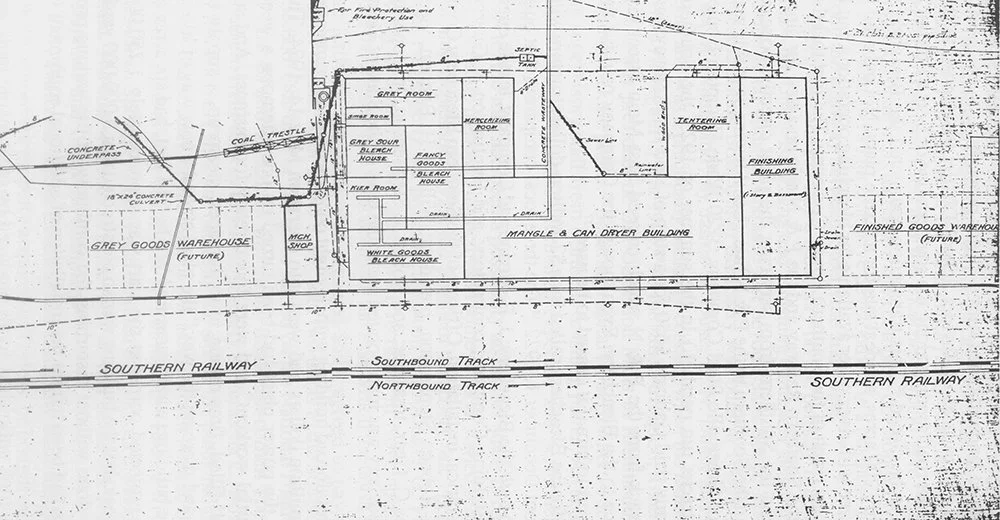
when construction started on the Southern Bleachery. Designed by J.E. Sirrine & Co., the plant opened in May 1924, offering Southern textile mills a local place to bleach, dye, and finish fabric. It quickly became the area’s economic engine. In 1928, the Piedmont Print Works was built next door, and by 1938, the two had merged to form the Southern Bleachery and Print Works.
At its peak, the Mill employed over 1,000 people and anchored a thriving village—complete with a company store, churches, baseball fields, and even a nine-hole golf course. The bleachery handled fabric processing, while the print works designed and printed patterns. It wasn’t just a job site. It was a place of purpose and connection.
That era came to an end in 1965, when the company was sold to Burlington Industries and shut down shortly after. The closure hit the Taylors community hard. Local businesses shuttered. The mill buildings stood mostly quiet for decades—used only occasionally, never fully reimagined.

That changed in the early 2000s.
Kenneth Walker purchased a few of the outbuildings in 2006, then acquired the main structure in 2008, offering affordable space to small businesses. What started as a practical decision sparked unexpected momentum: artists, craftsmen, and entrepreneurs saw something here worth investing in.
In 2015, Caleb Lewis purchased the property and expanded the vision. Since then, the Mill has grown steadily—now home to over 70 tenants. With nearly 63 acres and over 750,000 sq ft, the Mill is constantly evolving with ongoing development and growth. The focus is building a destination where history lasts and time is well spent.
Image by Travis Dove for The New York Times